Saturday, March 11, 2017


                 Grade 3/4 Maker Club


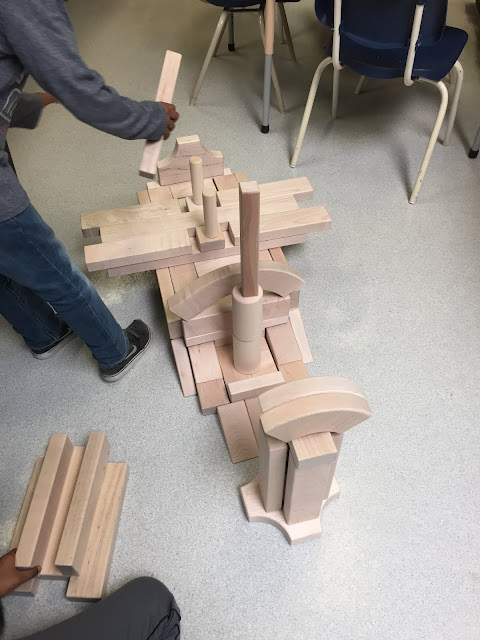
Both of our Maker Clubs are now wrapping up after many opportunities to invent, explore and create! Each day, students chose between different stations of their choice. Some of the favorite stations were: Lego, kapla blocks, big blocks, PVC pipes, beads, littleBits, and the maker carts. They created shelters, lighting arm bands, boats, structures, keychains, and more. 


"Maker education fosters curiosity, tinkering, and iterative learning, which in turn leads to better thinking through better questioning.  This learning environment fosters enthusiasm for learning, student confidence, and natural collaboration. Ultimately the outcome of maker education and educational makerspaces leads to determination, independent and creative problem solving, and an authentic preparation for real world by simulating real-world challenges."


Friday, February 10, 2017


                  More Lego and Learning!

Lego bricks are naturally engaging to students. They have the power to ignite the student's natural curiosity to explore, discover, and create. Students learn subjects like language arts, science, technology, engineering, and math more effectively, while improving and developing their 21st century skills, such as collaboration, creativity, communication, and critical thinking. 


This week, our Lego bricks turned numbers from thought to form - into real models that can be touched, compared, and discussed.  After the grade 3/4 students in room 7/8 designed, built, and tested their catapults, they recorded all the distances on chart paper. They were challenged with the question, "How might you represent this data using the lego?" Although challenging at first, all groups came up with different representations, all showing the same data! 

Sunday, January 15, 2017

Lego and littleBits in the 

Learning Commons


Students across the grades had the opportunity to come to the Learning Commons to explore, learn, create, collaborate, code, invent and play with Lego and littleBits this week.  


Monday, January 2, 2017

                              Celebration of Learning


Thank you everyone who visited the Learning Commons during our Celebration of Learning! Parents and their children had the opportunity to participate in some design/maker challenges. 

Take a look!


Watch the tower collapse in slow motion:


Sunday, December 11, 2016


Last week our students had the opportunity to participate in Hour of Code. The Hour of Code is a global movement by Computer Science Education Week and Code.org reaching tens of millions of students in 180+ countries through a one-hour introduction to computer science and computer programming.

However, coding is not new to many of our students. We had a Coding Club for grade 1/2 students this past term where the students learned fundamentals of coding through different coding games. 


Sunday, November 20, 2016

      What does it mean to be a good Digital Citizen?

Digital citizenship can be defined as the norms of appropriate, responsible behavior with regard to technology use.

Here are the nine themes of Digital Citizenship as taken up by all classes at CJFS:
1. Digital Access
2. Digital Commerce
3. Digital Communication
4. Digital Literacy
5. Digital Etiquette
6. Digital Law
7. Digital Rights and Responsibilities
8. Digital Health and Wellness
9. Digital Security


We had our students watch this video, then asked them, "How do I keep myself safe online? What should I never share online? What is a digital footprint?" Please watch and discuss with your child. 

https://www.youtube.com/watch?v=uwY6KsipuJQ

Thursday, September 15, 2016

Welcome to the Learning Commons!


What is the difference between a library and a learning commons?

Think of it as a shift from the dining room where food (knowledge) is passively consumed to the kitchen where knowledge is created (and is sometimes messy)!


As schools change, school libraries must also evolve from simply providing information to students to engaging students and helping prepare them to become critical thinkers, evaluators, users, and creators of information and knowledge.

In addition to providing access to traditional forms of knowledge like books, periodicals and print information, students have access to other forms of media and devices they will need to create and share. Students can determine how best to use the space and resources to study or to work on school assignments, projects or coursework individually or with others.

Students, parents, teachers, administrators, and the community can also use the space for instruction, social or collaborative learning, production and presentation.

Benefits

Benefits of Learning Commons include:
  • Learning commons promote global and cultural understanding as students collaborate with their local and broader community to investigate and create solutions to complex problems
  • Learning commons emphasize active and collaborative engagement and encourage the co-creation of knowledge by all learners
  • The virtual aspect of a learning commons (a VLC) promotes more efficient use of technology for creation and sharing of knowledge as well as enabling 24/7 access to resources and shared collaborative space for all students
  • Research shows improved student achievement and literacy development for students who have access to quality school library services, which include learning commons
(From Alberta Education and Education Matters)